Google Search Console Platform Properties: How Social and Video Tracking Changes Content Marketing
Google Search Console Platform Properties give businesses new insight into how social and video content is discovered through Google. Learn how the reporting can connect search, social media, video, and website content into a smarter, data-driven content strategy.


Google Search Console has traditionally been one of the most important tools for understanding how a website performs in Google Search. Marketers could see the queries bringing people to a website, measure impressions and clicks, identify high-performing pages, and use that information to improve SEO.
But the boundaries between search and social media have become increasingly difficult to separate.
Someone looking for a local business, product, tutorial, service, or recommendation might discover a traditional website in Google Search. They might also discover an Instagram post, TikTok video, X post, or YouTube video.
Google Search Console Platform Properties give marketers greater visibility into that second journey.
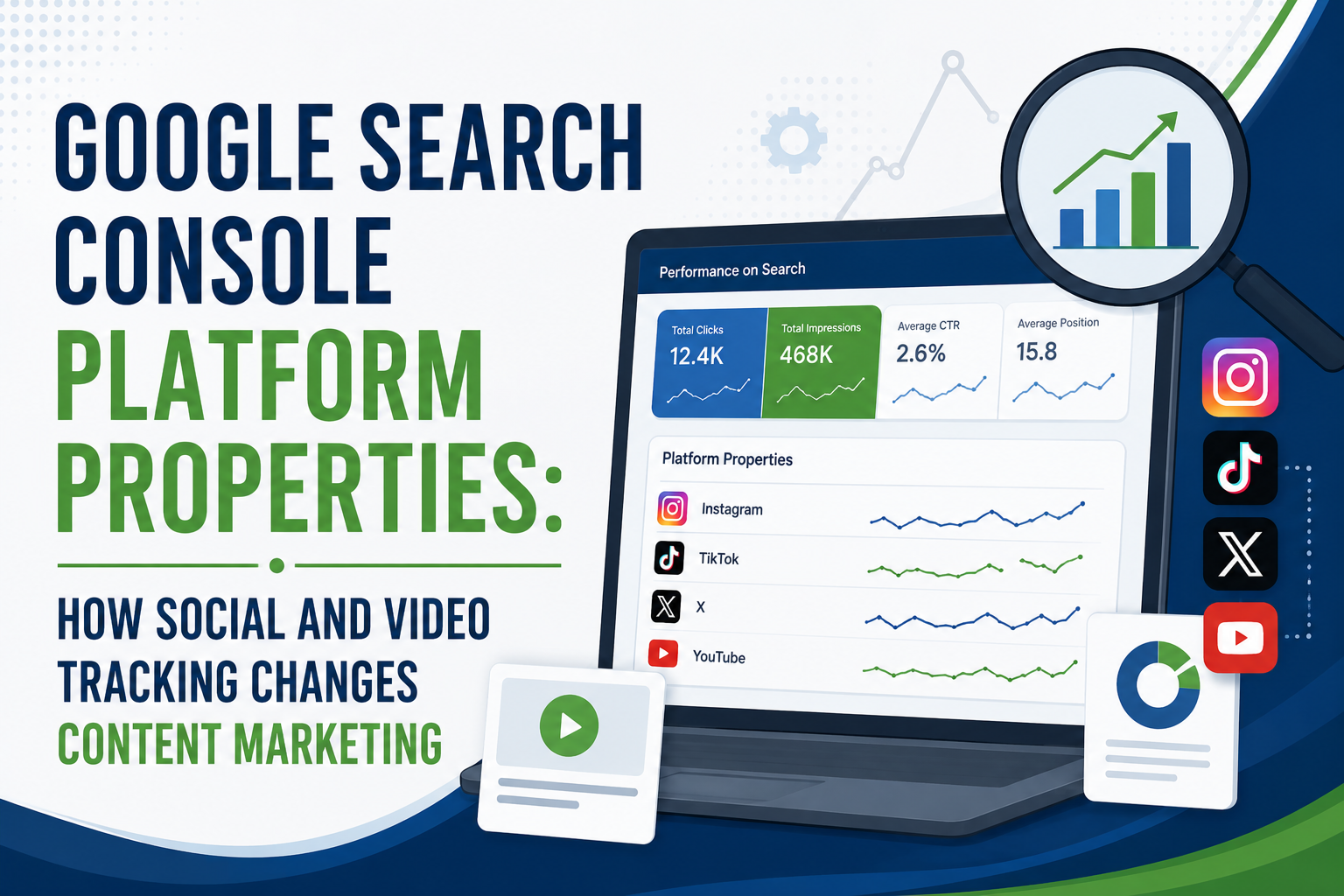
Google's new reporting allows eligible social and video accounts to be connected to Search Console so marketers can understand how their content performs when people encounter it through Google. The initial supported platforms are Instagram, TikTok, X, and YouTube. Businesses can analyze search queries, clicks, impressions, individual content performance, and broader traffic patterns associated with their social and video content.
For business owners, the importance of this update goes beyond another dashboard.
It changes what businesses can measure.
For years, social media marketing and SEO have often been managed as separate marketing channels. Search Console Platform Properties provide another reason to reconsider that separation. When social posts and videos can appear in Google and generate measurable search visibility, content created for a social platform can also become part of a broader search strategy.
What Are Google Search Console Platform Properties?
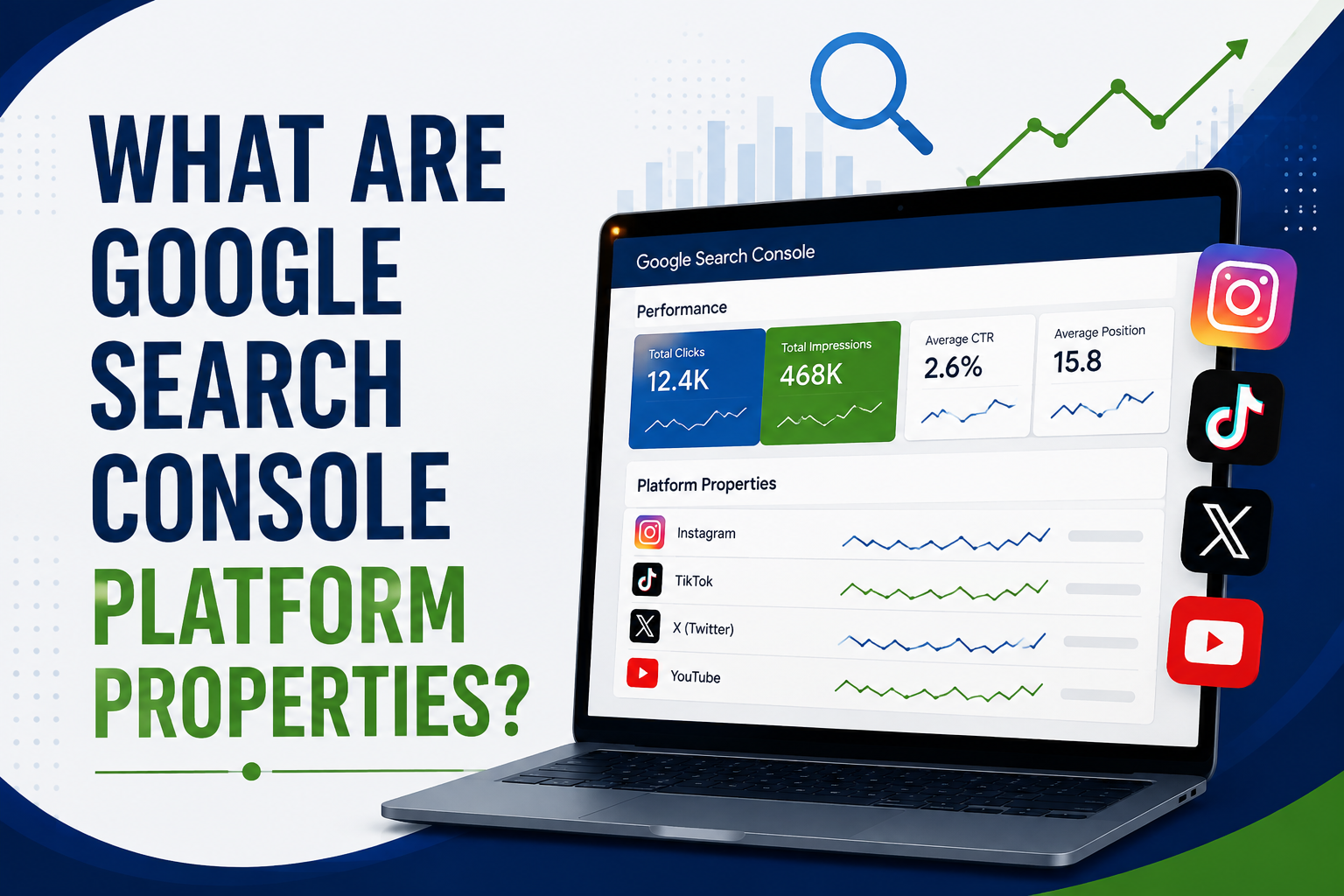
Google Search Console Platform Properties are a new property type that lets publishers and creators connect supported social media and video accounts to Google Search Console.
Instead of restricting Search Console reporting to websites a business owns or manages, Platform Properties provide reporting for content hosted on third-party platforms.
At launch, Google supports:
- TikTok
- X
- YouTube
Once an account is connected and verified, Search Console can provide information about how that account's content performs through Google's search ecosystem.
This is significant because businesses do not control these platforms in the same way they control their websites.
Your Instagram posts live on Instagram. Your TikTok videos live on TikTok. Your YouTube videos live on YouTube. Previously, businesses largely depended on the analytics provided by those individual platforms to evaluate content performance.
Those analytics remain important. Platform Properties do not replace them.
What changes is the ability to see the Google side of the discovery journey.
A business may know that a YouTube video received 15,000 views, for example. YouTube Analytics can tell the business a great deal about those viewers and how they interacted with the video.
Search Console can answer a different question:
How are people discovering that content through Google?
That distinction is what makes Platform Properties particularly useful for SEO and content marketing.
What Google Search Console Platform Properties Can Show You
Platform Properties bring familiar Search Console concepts to social and video content.
Depending on the available reporting, marketers can analyze information such as:
- Total clicks
- Total impressions
- Search queries
- Individual content performance
- Recent traffic patterns
- Top-performing posts
- Search discovery trends
Google's reporting can therefore help marketers determine not simply whether a piece of social content received engagement, but whether it is being discovered by people actively searching for information.
Search Console's Insights reporting can also help identify successful posts and how audiences are finding an account through Google.
That can be extremely valuable when developing a content strategy.
Suppose a Phoenix landscaping company publishes 20 short videos during the summer. Several receive strong engagement on Instagram, but one video explaining how often homeowners should water their lawn during extreme Arizona heat begins receiving consistent impressions from Google.
That is a different signal.
The business has discovered not merely an engaging social post, but a topic connected to real search demand.
The marketing team could then turn that insight into:
- A more comprehensive website article
- A longer YouTube video
- Additional Instagram Reels
- A frequently asked question on a service page
- A Google Business Profile post
- A follow-up TikTok
- A downloadable seasonal lawn-care guide
One search insight can therefore influence content across several marketing channels.
Platform Properties Are Not the Same as Social Media Analytics
This distinction is essential.
Google Search Console Platform Properties do not suddenly give businesses complete analytics for Instagram, TikTok, X, or YouTube.
Search Console is reporting on how supported content performs through Google's ecosystem.
The social platforms' own analytics remain the appropriate source for metrics such as platform-native engagement, follower behavior, audience demographics, watch behavior, and other metrics specific to those platforms.
Think of the difference this way:
The opportunity comes from examining these data sources together rather than treating them as competing measurement systems.
A TikTok may perform moderately inside TikTok but attract meaningful Google search visibility over time. Another video may become extremely popular within a social platform while generating very little Google visibility.
Neither outcome automatically makes one piece of content better than the other.
They are fulfilling different functions.
Why Google Search Console Platform Properties Matter for Content Marketing
Content marketing has traditionally been organized around the platform where content is published.
A blog article was about SEO content.
An Instagram Reel was social content.
A YouTube video was video content.
A TikTok was short-form social content.
Those categories remain useful operationally, but they do not necessarily reflect how people discover information today.
Search results increasingly connect users with different formats and platforms. That means the question for marketers is shifting from "Where did we publish this?" toward "Where can customers discover this?"
That is a much more useful way to think about modern content marketing.
The change also complements a broader shift in search. As we discussed in Weslo's guide to how AI search is changing SEO, businesses increasingly need to think beyond the traditional model of ranking ten blue website links on a search results page.
Search visibility now involves multiple content types, platforms, and discovery experiences.
Platform Properties give businesses another source of data for understanding that environment.
Search and Social Media Are Becoming More Connected
SEO and social media have long influenced one another indirectly.
A business might use social media to distribute a blog article. A successful social campaign might generate branded searches. A YouTube video might rank in Google. A customer might encounter a company on Instagram and later search for the brand by name.
But measuring these relationships has often been difficult.
Platform Properties make one part of that relationship clearer because marketers can see the Google queries associated with discovery of supported social and video content.
For content marketers, that information can reveal something extremely valuable:
the language customers actually use when searching for the subjects covered by your social content.
That can influence far more than social media captions.
It can inform SEO keyword research, website content, video topics, FAQs, service-page copy, blog planning, and future social campaigns.
Search Data Can Help Replace Guesswork With Evidence
One of the biggest content marketing problems for small and midsize businesses is deciding what to publish.
Teams often build content calendars around assumptions:
"Customers probably want to know about this."
"This topic seems popular right now."
"Our competitors are posting about this."
Those instincts can sometimes be right, but data provides a stronger foundation.
Google's guidance around Platform Properties encourages marketers to examine search audiences, identify trending content, compare content across platforms and formats, and use performance information to improve existing content.
That creates a useful feedback loop:
Publish → Measure → Identify Search Demand → Improve → Repurpose → Measure Again
For businesses already developing a structured social media content plan, Platform Properties can add another layer of evidence to editorial decisions. That content-planning resource is also an existing URL in Weslo's supplied sitemap.
Instead of evaluating content only by likes, comments, views, and shares, marketers can begin asking:
Did this content answer something people are actively searching for?
That is a very different measure of value.
What Social and Video Search Data Can Tell You About Your Audience

One of the most valuable aspects of Google Search Console Platform Properties is the ability to connect content performance with search behavior.
Social analytics typically tell marketers what happened after someone encountered a post. Search data can provide additional context about what that person was looking for before discovering the content.
That distinction matters.
A local HVAC company, for example, might publish a short video explaining why an air conditioner is blowing warm air. If that video begins appearing for Google searches related to AC problems, the business has learned something much more useful than the video's view count.
It has identified a specific customer problem connected to measurable search demand.
Businesses can use those insights to better understand:
- Questions potential customers are asking
- Problems generating search interest
- Topics gaining visibility
- Content formats attracting search clicks
- Posts that continue generating discovery after publication
- Subjects worth expanding into additional content
The result is a more evidence-driven content strategy.
Instead of treating every post as a temporary piece of social content, marketers can identify which posts have the potential to become larger marketing assets.
Search Queries Can Become Content Ideas
Search queries have always been valuable for SEO.
If a business discovers that a website page receives impressions for a particular search, the marketing team can improve the page around that intent or develop supporting content.
The same principle can now be applied more directly to supported social and video content.
Imagine a Phoenix pool company publishes a short Instagram video titled:
"Why Is My Pool Water Cloudy?"
The video starts generating Google impressions for related searches such as:
- why is my pool cloudy
- cloudy pool water Phoenix
- how to clear cloudy pool water
- pool cloudy after monsoon
- how long does cloudy pool water take to clear
Those queries reveal multiple potential content opportunities.
The company could create a detailed website guide about cloudy pool water. It could produce another video specifically addressing pool problems after Arizona monsoon storms. It could add related questions to an FAQ section or develop several short-form videos addressing individual causes.
One successful piece of content becomes the starting point for an entire topic cluster.
That is where Google Search Console Platform Properties can become particularly useful for content planning.
High-Impression, Low-Click Content Can Reveal Opportunities
Clicks are valuable, but impressions can be equally informative.
A social post or video receiving significant Google impressions but relatively few clicks may indicate that Google sees the content as relevant to a topic, while something about its presentation is not attracting enough users.
Depending on the platform and content type, marketers can investigate factors such as:
- The topic
- Headline or video title
- Description
- Thumbnail
- Search intent
- How clearly the content answers the query
- Whether a better or more comprehensive piece of content should be created
This is similar to the way experienced SEO teams analyze website pages.
A page with thousands of impressions and few clicks is not necessarily a failure. It may be an opportunity sitting in plain sight.
The same thinking can now extend to supported social and video content.
How Platform Properties Change the Role of Social Media Content
Social media content has historically had a relatively short perceived lifespan.
A business publishes a post, receives engagement for a few hours or days, and then moves on to the next piece of content.
That model encourages volume.
But search discovery can change the economics of content creation.
A useful video or post that remains discoverable through Google may continue attracting potential customers well after the initial social engagement has slowed.
That means marketers should think about at least two potential audiences when creating content:
The social audience: people encountering the content through their feeds.
The search audience: people encountering the content because they are actively looking for information.
Those audiences can overlap, but their intent can be very different.
A person casually watching a landscaping video on Instagram may simply find it interesting.
Someone searching Google for "best grass for Phoenix backyard" has expressed a specific need.
If the same piece of content can reach both users, its potential marketing value increases significantly.
Evergreen Social Content Becomes More Valuable
This development strengthens the case for creating evergreen social content.
Not every post needs to be evergreen. Businesses still benefit from timely content, company updates, events, trends, promotions, community involvement, and behind-the-scenes posts.
But informational content deserves a larger role in the strategy.
Examples include:
- How-to videos
- Frequently asked questions
- Product comparisons
- Service explanations
- Common mistakes
- Cost explanations
- Before-and-after examples
- Troubleshooting content
- Local guides
- Customer education
- Myth-versus-fact posts
These topics can remain useful long after publication.
For Phoenix businesses in particular, locally specific educational content can create an additional opportunity.
A roofing company might discuss how Arizona heat affects roofing materials.
An HVAC contractor might explain air-conditioning efficiency during extreme summer temperatures.
A landscaping company might discuss desert irrigation.
A pest-control company might explain seasonal pest activity.
The goal is not to stuff location keywords into every social post.
The goal is to create genuinely useful content around the questions local customers are already asking.
That same principle is fundamental to local SEO, where relevance, local visibility, and matching customer search intent are critical to attracting qualified prospects.
Video Should Become a Bigger Part of Search Strategy

The inclusion of YouTube and short-form video platforms is particularly important.
Video is no longer simply a social-media format.
People use video to learn how something works, evaluate products, compare companies, troubleshoot problems, research purchases, and decide which businesses they trust.
Google can surface video content during those discovery journeys.
That makes video useful at multiple stages of the customer journey.
Awareness
Short educational videos can introduce potential customers to a business while answering broad questions.
Consideration
More detailed videos can explain services, demonstrate expertise, address objections, or compare possible solutions.
Decision
Testimonials, case studies, project walkthroughs, demonstrations, and company videos can help prospective customers decide whether they trust a business enough to make contact.
This means video production should increasingly be connected to SEO and content planning rather than managed as a completely separate creative activity.
Businesses investing in video production and editing can get more value from that investment when topics are selected with both audience engagement and search demand in mind.
One Search Topic Can Support Multiple Content Formats
Consider a local remodeling company researching the question:
"How much does a kitchen remodel cost in Phoenix?"
Instead of creating only a blog post, the company could develop a content ecosystem around the topic.
The primary article might provide the detailed answer.
A YouTube video could walk viewers through typical project costs.
An Instagram Reel could explain three factors that increase remodeling costs.
A short TikTok could address one common pricing misconception.
A social graphic could summarize the primary cost ranges.
A related case study could demonstrate what a real project involved.
Each asset serves a different purpose, but all of them revolve around the same customer question.
Platform Properties can help marketers determine which of those social and video assets also gain traction through Google.
A Better Model for Content Marketing: Create Once, Expand Strategically
One mistake businesses make with content repurposing is assuming it means posting exactly the same thing everywhere.
It does not.
Effective repurposing takes the central idea and adapts it to the expectations of each platform.
A detailed blog article might become:
- A 10-minute YouTube explanation
- Three short vertical videos
- An Instagram carousel
- Several short posts
- A customer email
- A Google Business Profile update
- An FAQ
- A sales-team resource
The idea remains consistent while the presentation changes.
Google Search Console Platform Properties can add another layer to this process because search performance can help determine which ideas deserve further investment.
If a topic performs well, expand it.
If a particular question repeatedly generates impressions, answer it more comprehensively.
If a video gains unexpected Google visibility, consider building website content around the same intent.
If several related posts perform well, consider creating a larger topic cluster.
This creates a content system rather than an endless publishing calendar.
Website Content Still Needs to Be the Foundation
The increased visibility of third-party content does not mean businesses should abandon their websites.
Quite the opposite.
Your website remains an owned digital asset.
Social platforms can change algorithms, features, account policies, distribution models, and visibility rules. Businesses have considerably more control over their own websites.
The stronger strategy is therefore not:
Website or social media.
It is:
Website + search + social media + video.
Each channel plays a different role.
Social platforms can generate awareness and engagement.
Video can build familiarity and trust.
Search can capture active demand.
The website can turn that demand into inquiries, calls, appointments, purchases, and other conversions.
If visitors reach the website but fail to take the next step, increased visibility alone will not solve the problem. Weslo's guide explaining why websites get traffic but no leads explores that conversion gap in greater detail.
The goal is to connect these channels into one customer journey.
How Local Businesses Can Use Platform Properties

The implications are particularly interesting for local businesses because local buying journeys rarely happen in one place.
Imagine someone needs a landscaper.
They might:
- Search Google for landscaping companies.
- Look through Google Maps results.
- Visit several websites.
- Watch a company's videos.
- Look through its Instagram account.
- Read reviews.
- Search the company name.
- Return to the website.
- Call for an estimate.
Traditional attribution can make this journey look fragmented.
From the customer's perspective, however, it is one research process.
Platform Properties help businesses understand another piece of that process.
Use Search Data to Identify High-Intent Questions
Local businesses should pay particular attention to queries that indicate someone is moving closer to a purchasing decision.
Informational queries can be valuable, but commercial questions may have even greater business value.
Compare:
"What is local SEO?"
with:
"local SEO company Phoenix"
The first query indicates someone wants information.
The second may indicate someone is looking for a provider.
Both deserve attention, but the appropriate content and next step are different.
Marketers should therefore look beyond raw impression numbers and evaluate the intent behind the searches producing those impressions.
Connect Search Visibility With Local Presence
Google Business Profile should remain another important component of this strategy for local companies.
A prospective customer may encounter a video or social post in Google and then search the company's name. What they find next can determine whether that discovery becomes a lead.
A complete Google Business Profile, strong reviews, accurate information, current photos, useful posts, and a well-optimized website can all reinforce trust.
Businesses that need to strengthen this part of their local presence can use Weslo's step-by-step Google Business Profile guide. Search visibility should therefore be considered part of a connected local marketing system rather than an isolated ranking exercise.
What Different Content Formats Can Do
How to Use Google Search Console Platform Properties in Your Content Strategy
The value of Google Search Console Platform Properties will ultimately depend on what businesses do with the information.
Adding another analytics dashboard does not improve marketing by itself.
The opportunity comes from turning search data into better decisions about topics, formats, distribution, optimization, and future content.
A practical workflow can be built around five stages:
- Connect and verify the relevant platform accounts.
- Establish a baseline for current Google visibility.
- Identify content and queries showing meaningful search demand.
- Expand successful topics across appropriate channels.
- Measure what happens and refine the strategy.
This creates an ongoing content feedback loop rather than a one-time reporting exercise.
Step 1: Connect the Platforms That Matter to Your Business
Businesses do not necessarily need to use every supported social platform simply because Google can report on it.
Start with the platforms already playing a meaningful role in your marketing.
For many local businesses, that could mean Instagram and YouTube. Other companies may be particularly active on TikTok or X.
The objective should not be to increase the number of channels your team manages.
The objective is to understand the search visibility of content you are already creating and determine where additional investment makes sense.
Once the relevant accounts are connected, avoid making major strategic decisions from a few days of data.
Build a baseline.
Look at what is already happening before trying to change it.
Step 2: Identify Which Content Google Is Already Surfacing
One of the first questions to investigate is simple:
Which of our existing social posts and videos are already earning Google visibility?
Look for patterns.
Perhaps tutorials consistently generate impressions.
Maybe customer questions perform better than promotional posts.
Perhaps videos explaining costs attract more searches than videos showing completed projects.
You may discover that highly polished promotional content receives strong engagement on social media while relatively simple educational content performs better through Google.
That information can influence the balance of your future content calendar.
Do not evaluate only the single best-performing post.
Look for patterns across groups of content.
If several posts about pricing receive search visibility, pricing may deserve a larger content cluster.
If videos addressing common mistakes repeatedly appear in search, create more of them.
If local educational topics perform well, develop additional locally specific resources.
Individual results are interesting.
Patterns are actionable.
Step 3: Analyze the Queries Behind the Visibility
Next, examine the search queries associated with your content.
The objective is not simply to collect keywords.
Try to understand why the person searched.
Queries can generally reveal different forms of intent, including:
Informational Intent
The searcher wants an answer.
Examples:
- how does local SEO work
- why is my AC running constantly
- how often should I post on Instagram
Commercial Investigation
The searcher is comparing options or researching a purchase.
Examples:
- SEO vs Google Ads for local business
- best marketing agency for contractors
- website redesign cost
Transactional or High-Intent Searches
The user appears closer to taking action.
Examples:
- local SEO agency Phoenix
- HVAC company near me
- Phoenix landscaper estimate
Understanding intent helps determine what should happen next.
An informational query may deserve a blog article or educational video.
A commercial query may deserve a comparison page, case study, or detailed service explanation.
A high-intent query may reveal an opportunity to strengthen a service page or conversion path.
The search term is therefore only the beginning.
The business opportunity lies in understanding the need behind it.
Step 4: Turn Successful Social Topics Into Website Assets
One of the strongest uses of Platform Properties is identifying ideas that deserve expansion.
Suppose an Instagram Reel answering a simple customer question begins generating substantial Google visibility.
Instead of simply celebrating the Reel's performance, ask:
Do we have a comprehensive website resource answering this question?
If not, the search data may have identified a content gap.
The business could create:
- A detailed blog article
- A service-page section
- An FAQ
- A downloadable resource
- A case study
- A comparison page
- A longer video
This process allows social media to become a testing ground for content ideas.
Short-form content is relatively quick to create. Businesses can publish useful ideas, observe audience and search response, and then invest more heavily in topics demonstrating demand.
For marketers, that is considerably more efficient than developing large content assets entirely from assumptions.
Step 5: Turn Successful Website Topics Into Social and Video Content
The process should also work in the opposite direction.
Your website Search Console property may already reveal pages and queries performing well in Google.
Those topics can provide excellent starting points for social content.
If a blog article consistently attracts search traffic, turn its key ideas into short videos.
If a service page receives impressions for several frequently asked questions, create a social series answering them.
If an article contains five major recommendations, each recommendation could potentially become an individual post.
The relationship should therefore be circular:
Website search data → social content → Platform Properties data → improved website content → additional social content
That is a far more sophisticated content system than independently planning blogs, social posts, videos, and SEO.
Step 6: Measure Business Outcomes, Not Just Visibility
Search impressions are useful.
Clicks are better.
Leads and revenue ultimately matter more.
Businesses should avoid replacing one set of vanity metrics with another.
A social video receiving 100,000 Google impressions sounds impressive, but if those impressions have little relevance to the company's services or customers, their commercial value may be limited.
Conversely, a highly specific video receiving only a few hundred impressions might reach people with strong purchasing intent.
Consider a commercial roofing company.
A broadly entertaining construction video might attract thousands of views.
A detailed video answering "How much does commercial roof replacement cost in Phoenix?" might attract substantially fewer viewers.
But the second audience could be far more valuable.
That is why content performance should ultimately be evaluated against business objectives.
Useful questions include:
- Did branded searches increase?
- Did qualified website traffic increase?
- Are more visitors reaching service pages?
- Did calls or form submissions increase?
- Are people mentioning videos or social content during sales conversations?
- Are certain topics consistently associated with higher-quality leads?
- Are content-assisted conversions increasing?
Marketing visibility matters when it contributes to business growth.
What Metrics Should Businesses Monitor?
There is no single metric that determines whether a content strategy is successful.
Businesses should combine several measurements.
Google Search Visibility Metrics
Monitor:
- Impressions
- Clicks
- Search queries
- Content receiving search visibility
- Changes in visibility over time
Social Platform Metrics
Continue monitoring native platform metrics such as:
- Views
- Engagement
- Shares
- Saves
- Watch time
- Follower growth
- Profile activity
Website Metrics
Evaluate what users do after reaching your website:
- Organic traffic
- Landing-page performance
- Engagement
- Conversion rate
- Form submissions
- Calls
- Appointment requests
Business Metrics
Ultimately connect marketing activity with:
- Qualified leads
- Customer acquisition
- Revenue
- Customer acquisition cost
- Return on marketing investment
The more effectively these layers are connected, the easier it becomes to distinguish content that merely attracts attention from content that contributes to growth.
A Practical Platform Properties Measurement Framework
Common Mistakes to Avoid With Platform Properties
New reporting capabilities often create excitement, but they can also encourage businesses to draw conclusions too quickly.
There are several mistakes worth avoiding.
Mistake 1: Treating Impressions as Leads
An impression means content had visibility.
It does not mean the person became a prospect.
Use impressions to understand reach and search opportunity, then follow the customer journey further.
Mistake 2: Optimizing Every Post for Search
Social content still needs to work socially.
Turning every Instagram caption or TikTok into an awkward collection of keywords can damage the user experience.
Create content for people first.
Search insights should help identify useful topics and clearer language, not encourage keyword stuffing.
Mistake 3: Abandoning Platform-Native Analytics
Platform Properties answer specific questions about Google visibility.
They do not replace Instagram Insights, TikTok Analytics, YouTube Analytics, or other native reporting.
The strongest analysis combines the available datasets.
Mistake 4: Chasing Traffic That Has No Commercial Relevance
A topic can generate enormous search volume and still have little value to your business.
Prioritize relevance over raw reach.
A smaller audience consisting of potential customers is generally more valuable than a massive audience with no realistic reason to buy from you.
Mistake 5: Forgetting About Conversion
Discoverability is only the beginning.
If people find your business but encounter a confusing website, weak offer, poor user experience, or unclear next step, increased visibility may simply expose more people to a broken conversion process.
Search, social, content, website experience, and conversion strategy must work together.
What This Means for SEO Going Forward
The broader lesson behind Google Search Console Platform Properties is not that social media has suddenly replaced traditional SEO.
It has not.
Technical SEO still matters.
Website content still matters.
Local optimization still matters.
Links, site structure, user experience, and search intent still matter.
What is changing is the range of content marketers need to consider when thinking about search visibility.
SEO increasingly involves helping businesses become discoverable wherever Google can surface relevant information.
That may include:
- Website pages
- Blog articles
- Videos
- Social posts
- Business profiles
- Images
- Reviews
- Other useful digital assets
The businesses best positioned for this environment will not necessarily be the ones publishing the most content.
They will be the ones creating the most useful connected content ecosystems.
Build Content Around Customer Questions, Not Individual Platforms
The most practical way to respond to this shift is to stop beginning every content discussion with the platform.
Instead of asking:
"What should we post on Instagram this week?"
Start with:
"What does our customer need to know this week?"
Then decide which formats best answer that question.
A valuable customer question might become a detailed website article, short Instagram Reel, TikTok explanation, YouTube video, Google Business Profile post, sales resource, and email.
Each piece can reinforce the others.
And now, through Platform Properties, marketers have another way to understand which social and video assets are also earning visibility through Google.
That makes content planning more measurable, more connected, and potentially much more efficient.
Turn Search Visibility Into a Smarter Content Strategy
Google Search Console Platform Properties represent an important change in how businesses can evaluate their digital presence.
For years, marketers have talked about SEO, social media, video, website content, and local marketing as separate channels.
Customers rarely experience them that way.
They search, scroll, watch, compare, read, return, and search again.
Platform Properties give marketers greater visibility into one part of that interconnected journey and provide another source of evidence for deciding what content deserves attention.
The opportunity is not simply to collect more data.
It is to use that data to understand what customers want, identify topics with genuine demand, create better content, repurpose successful ideas intelligently, and connect discovery with measurable business outcomes.
For local businesses, that means the future of content marketing is increasingly less about producing isolated posts and more about building a coordinated digital presence around the questions customers are already asking.